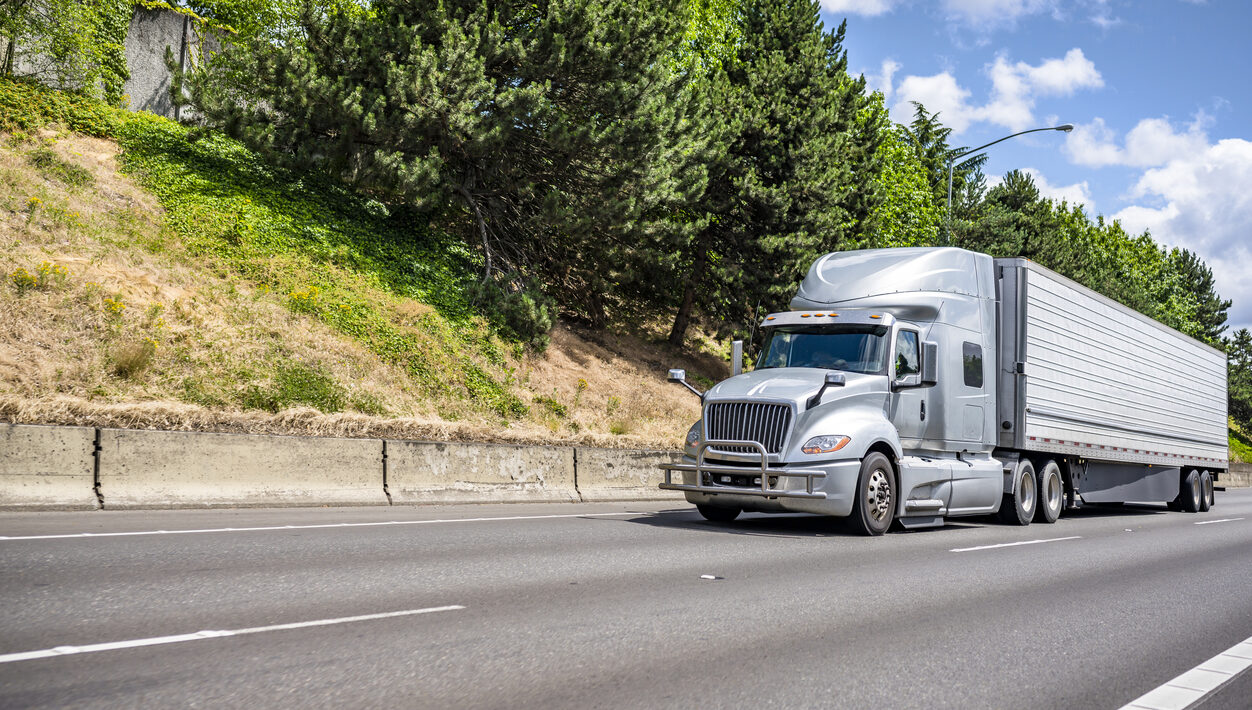
Kentucky trucking runs on tight margins and tighter deadlines. Auto parts move from Toyota’s Georgetown plant on a just-in-time schedule, bourbon leaves Franklin County by the tanker load, and UPS routes more air cargo through Louisville’s Worldport hub than any other airport on earth.
One accident without the right commercial trucking insurance can end a Kentucky operating authority in a single afternoon.
Quick Answer: Commercial trucking insurance in Kentucky averages $7,500 to $15,000 a year for a semi-truck, and $6,000 to $11,500 for a hot shot rig, per Alvix’s 2026 carrier data. Intrastate carriers need only $60,000 in state liability plus $10,000 in Personal Injury Protection, but that changes the moment a truck crosses into Ohio, Indiana, or Tennessee, where federal minimums of $750,000 (or $5,000,000 for hazmat) apply instead.
Key Takeaways
- Two different rulebooks apply. Kentucky’s $60,000 state minimum only covers trucks that never leave the state; cross a border and federal law controls instead.
- Form E is not optional paperwork. The Kentucky Transportation Cabinet suspends operating authority automatically the moment a carrier’s insurer reports a lapse.
- Trucks at 60,000 pounds or heavier need a KYU number, a separate weight-distance tax account, on top of insurance.
- Renewal shock hits even claims-free accounts. We track increases of 20% to 40% at renewal on Kentucky policies with zero filed claims.
- The “Cut in the Hill” and Jellico Mountain Pass account for a disproportionate share of Kentucky’s serious truck claims.
- Ports and intermodal shippers reject carriers whose policy lacks a Truckers Uniform Intermodal Interchange (UIIA) endorsement, usually discovered only after a load falls through.
- Six specific policy line items (stated value mismatches, duplicate non-trucking liability, oversized cargo limits, and more) are where we most often catch Kentucky owner-operators overpaying.
What’s Actually Driving Kentucky Trucking Insurance Costs in 2026
Premiums have climbed statewide for reasons that have nothing to do with any single driver’s record. Nuclear jury verdicts have pushed claim severity up nationally, and a modern semi costs far more to repair than the trucks these policies were priced against five years ago.
Kentucky carriers feel this even with a clean CSA score, because insurers price the whole book, not one truck. Renewal shock with zero claims filed is the pattern we see most across Kentucky owner-operator accounts, a jump of 20% to 40% for no reason the driver caused.
We’ve tracked increases as high as 118% on policies with six straight claim-free years, driven entirely by market repricing. Loyalty discounts barely exist in commercial trucking, so shopping the policy annually beats auto-renewing out of habit.
Watch the other end of that scale too: a quote 30% to 40% below every other bid is a warning sign, not a win.
That far below market usually means thin reinsurance backing or a policy built to non-renew after the first claim, a cheap policy that gets expensive fast the moment an actual claim hits.
Kentucky Trucking Insurance Cost by Vehicle Type
Every vehicle class carries different exposure. The ranges below reflect Alvix’s 2026 carrier data for Kentucky-domiciled authorities.
| Vehicle Type | Annual Premium in Kentucky |
|---|---|
| Box Truck Insurance | $4,000 – $8,500 |
| Hot Shot Trucking Insurance | $6,000 – $11,500 |
| Dump Truck Insurance | $7,500 – $14,000 |
| Semi Truck Insurance | $7,500 – $15,000 |
| Refrigerated (Reefer) Truck Insurance | $8,500 – $17,000 |
| Auto Hauler Insurance | $10,000 – $20,000 |
| Heavy Haul Insurance | $12,000 – $29,000 |
A hot shot rig sits at the low end because cargo values and stopping distances are smaller.
A reefer unit costs more because a single mechanical failure can spoil an entire load. An auto hauler carrying six vehicles insures $200,000-plus of cargo on every run, pricing it closer to heavy haul than a standard dry van.
Kentucky Trucking Insurance Costs by City
Where a truck garages changes the quote as much as what it hauls.
| City | Typical Cost Driver | Rate Impact vs. State Average |
|---|---|---|
| Louisville | UPS Worldport freight density, I-64/I-65/I-71 interchange congestion | Higher |
| Covington | Cincinnati-metro spillover traffic, Brent Spence Bridge bottleneck | Higher |
| Lexington | I-64/I-75 interchange construction zones | Slightly higher |
| Owensboro | Lower traffic density, rural highway exposure | Lower |
| Bowling Green | Corvette plant freight, I-65 corridor | Average |
Truck insurance in Louisville runs toward the top of every range above, since UPS alone moves enough freight through World port to keep dozens of carriers running daily routes.
Commercial trucking insurance in Covington prices similarly, driven by its position across from Cincinnati’s Brent Spence Bridge bottleneck.
Owensboro-based auto hauler trucking insurance prices lower, since western Kentucky’s lighter traffic cuts both accident and cargo-theft exposure.
Kentucky State vs. Federal Liability Requirements
Kentucky runs two separate systems depending on where a truck drives, and mixing them up is the most common compliance mistake new authorities make.
Intrastate carriers (Kentucky-only routes) must carry:
- $60,000 in combined primary liability, split as $25,000 per person, $50,000 per accident, $25,000 property damage.
- $10,000 in Personal Injury Protection, required because Kentucky is a no-fault state and pays a driver’s own medical bills regardless of who caused the crash.
Interstate carriers (crossing into Ohio, Indiana, Tennessee, West Virginia, or beyond) fall under federal rules instead:
- $750,000 minimum Bodily Injury Liability for general freight, per 49 CFR Part 387.
- $1,000,000 in practice, since most freight brokers refuse to tender a load below that figure.
- $5,000,000 for hazardous materials carriers.
Form E, KYU Numbers, and Staying Compliant with the Kentucky Transportation Cabinet
Buying a policy is only half the job. Kentucky also requires proof it stays active.
For-hire intrastate carriers need a Form E on file with the Kentucky Transportation Cabinet’s Motor Carriers Division. The insurer files it, and the moment a policy lapses, the Cabinet suspends operating authority the same day, no grace period. Interstate carriers file a BMC-91 or BMC-91X with the FMCSA instead.
Separately, any truck at 60,000 pounds or more on Kentucky’s public highways needs a KYU number for the state’s weight-distance tax, filed quarterly. A single-trip permit covers a one-time pass-through instead.
High-Risk Trucking Routes in Kentucky
Kentucky’s terrain creates specific accident corridors that underwriters price into every quote, whether a carrier drives them or not.
- I-75 Jellico Mountain Pass, near the Tennessee border, where sustained grades overheat brakes on loaded trucks.
- The “Cut in the Hill,” the steep I-71/I-75 descent into Northern Kentucky, one of the state’s most crash-dense stretches.
- I-64 through Lexington, where near-constant construction creates heavy rear-end and sideswipe risk.
Illustrative scenario: a dump truck loses brake pressure on a steep Eastern Kentucky grade and clips a guardrail before striking a passenger car. Kentucky’s no-fault PIP pays the driver’s medical bills immediately; primary liability then covers the roughly $40,000 in guardrail and vehicle damage.
Essential Coverage Types for Kentucky Fleets
State minimums keep a truck legal. They rarely keep a business solvent after a real accident.
- Cargo Freight Insurance: pays the shipper if freight is damaged or stolen in transit.
- Physical Damage Protection: repairs the truck; lenders require this on any financed rig.
- General Liability Insurance: covers non-driving incidents, like a slip-and-fall at a dock.
- Trailer Interchange Insurance: required whenever a carrier pulls a trailer it doesn’t own.
- Occupational Accident Insurance: covers an independent driver’s medical bills and lost income after a job injury.
- Non-Trucking Liability: covers the truck during personal, bobtail use outside dispatched runs.
Not every carrier gets accepted at the dock, either. Port and intermodal shippers turn away carriers whose policy skips the Truckers Uniform Intermodal Interchange (UIIA) endorsement, a gap most owner-operators learn about only after a broker rejects their certificate. Confirm this endorsement before hauling container freight into Louisville’s rail yards.
Where Kentucky Owner-Operators Actually Overpay
We review Kentucky trucking policies constantly, and the same six line items surface on nearly every one.
- Stated Amount above Actual Cash Value. A $45,000 truck insured for $80,000 “stated amount” still pays out at the lower figure.
- Duplicate non-trucking liability. Drivers already covered bobtail under a motor carrier’s policy who also buy their own coverage waste $300 to $600 a year.
- Cargo limits above real freight value. A $100,000 limit on dry van loads that never exceed $40,000 buys coverage that never gets used.
- Trailer interchange on trailers owned outright. This only matters for trailers pulled under someone else’s authority.
- Deductibles frozen since the policy was written. Moving physical damage from $1,000 to $2,500 commonly saves $400 to $900 a year.
- Radius of operation mismatched to actual routes. A 500-mile filing on a carrier running 250 miles pays long-haul rates for regional work.
Consolidating every truck under one policy also simplifies renewals and COI requests, and it is the single change we recommend most for Kentucky fleets running three or more units.
FAQs
Get Kentucky Trucking Insurance That Matches How You Actually Run
Kentucky’s rules are specific, and one wrong filing, a Form E mismatch, a missed KYU renewal, a lapsed policy, can park a truck faster than any accident. That is the gap Alvix Insurance Group was built to close.
Alvix has placed trucking-specific policies since 2014, with 24/7 certificate access so a broker’s office hours never hold up a load. Whether it is a hot shot rig out of Bowling Green or a mixed fleet moving auto parts through Louisville, Alvix Insurance Group matches coverage to the actual route and cargo, not a generic auto policy stretched to fit a rig.
Browse the Commercial Trucking Insurance Blog for more Kentucky guidance, check the trucking insurance glossary, or get a free Kentucky trucking insurance quote today.


