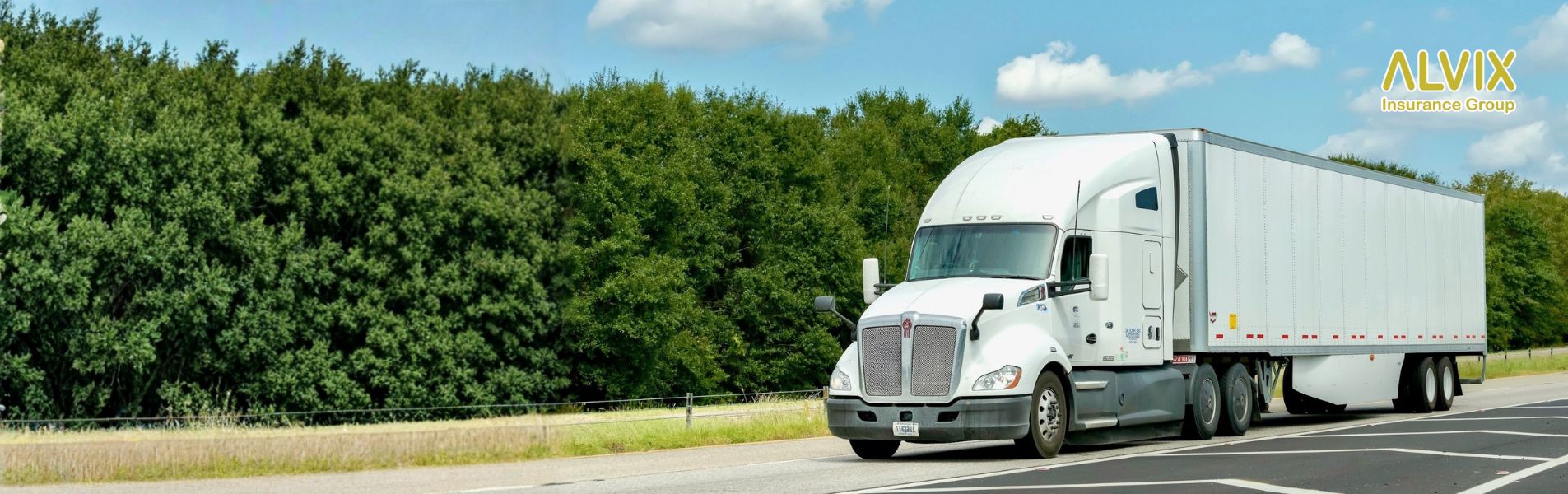
Commercial trucking insurance in New Mexico runs $7,000 to $18,000 a year for an established semi-truck. New authorities and specialty rigs often pay $12,000 to $30,000 or more.
Rates sit higher here than in most neighboring states. New Mexico mixes Permian Basin oilfield freight, long unpatrolled highways, and a high truck-crash fatality rate into a single risk pool.
Alvix Insurance Group has placed trucking policies across 23 licensed states, New Mexico included, since 2014. Here’s what drives your premium, what changed in 2024, and how to lower your renewal.
Quick Answer: New Mexico requires primary liability coverage on every trucking authority. The limit depends on cargo type and whether you run interstate or intrastate.Federal general freight carriers need $750,000. Oilfield and hazmat loads commonly need $1,000,000 or more, and brokers often push that floor higher before they’ll dispatch to you.
Key Takeaways for New Mexico Trucking Insurance
- New Mexico moved motor carrier authority from the Public Regulation Commission to the Department of Transportation on July 1, 2024.
- Established semi-truck operators typically pay $7,000 to $18,000 a year; new authorities pay $12,000 to $30,000 or more.
- Permian Basin oilfield hauling out of Lea and Eddy counties carries its own risk load, separate from general freight rating.
- Form E is still the standard proof-of-insurance filing. It now goes to NMDOT instead of the old Commission.
- Shopping your policy every 1 to 2 years is the single biggest lever on renewal cost, bigger than carrier tenure.
Why Commercial Trucking Insurance Is Required in New Mexico
Every truck running under its own authority in New Mexico needs proof of financial responsibility on file. That applies whether the load stays in-state or crosses into Texas, Arizona, or Colorado.
1. Federal FMCSA Liability Minimums for New Mexico Carriers
The federal financial responsibility minimums apply the moment a truck crosses state lines. General freight carriers need $750,000 in liability coverage.
Trucks under 10,001 lbs gross vehicle weight (GVW) hauling non-hazardous freight can run on $300,000. Hazmat and bulk commodities push that floor to $1,000,000 or $5,000,000.
Most brokers ask for $1,000,000 anyway, regardless of the legal minimum. A new venture quoted below that number usually can’t book broker freight.
2. New Mexico’s Form E Filing Since the 2024 NMDOT Transfer
Effective July 1, 2024, New Mexico shifted motor carrier regulation to the Department of Transportation’s new Transportation Regulation Bureau. Plenty of trucking sites still describe this as a Public Regulation Commission function. It isn’t anymore.
The Bureau now splits the work 3 ways:
- The Applications Unit processes operating authority and Unified Carrier Registration.
- The Compliance Unit tracks your Form E filing and annual report, due every March 1.
- The Inspections & Investigations Unit enforces the Motor Carrier Act and can suspend authority over violations.
Form E itself still follows the state’s proof-of-financial-responsibility rule (18.3.3.8 NMAC). A missed annual report can flag your authority for suspension, even with active coverage.
On the federal side, a process agent has to file your BOC-3, and your insurer has to file proof of coverage with FMCSA, both within 20 days of your application posting to the FMCSA Register. Miss that window and FMCSA dismisses the application and keeps your filing fee.
Core Coverage Every New Mexico Trucking Policy Needs
A complete policy layers several coverages together, not a single blanket limit.
1. Primary Liability and Physical Damage
Primary truck liability insurance pays for bodily injury and property damage when your truck is at fault. It’s the coverage NMDOT and the FMCSA actually check for.
Physical damage coverage repairs or replaces your truck and trailer after a collision, fire, theft, or weather event. Raising your deductible to $2,500 or $5,000 is one of the fastest ways to cut this line.
2. Cargo, Trailer Interchange, and General Liability
Cargo freight insurance protection covers freight loss, damage, or spoilage in transit. Most shippers won’t tender a load without it on file.
Trailer interchange insurance covers a non-owned trailer while it’s in your care. General liability insurance handles non-driving claims, like an injury at your yard.
| Coverage Type | What It Pays For | Typical NM Requirement |
|---|---|---|
| Primary liability | Bodily injury, property damage you cause | $750,000 general freight |
| Physical damage | Repair or replace your own truck/trailer | Set by truck value |
| Motor cargo | Freight loss, damage, spoilage | Often $100,000 broker floor |
| Trailer interchange | Non-owned trailer in your care | Set by interchange agreement |
| Hazmat/bulk liability | Bodily injury, spills, cleanup | $1,000,000–$5,000,000 |
What New Mexico Trucking Insurance Costs by Vehicle Type
Cost varies more by vehicle and freight type here than in flatter, lower-risk states. Oilfield and heavy-haul work carries a real premium over standard dry van freight.
1. New Authority vs. Established Operator Pricing
A new authority and a 20-year CDL holder starting the same company on the same day often see the same first quote. That’s not about driving experience.
It’s about the absence of a company loss run. Carriers price the business’s claims and inspection history, not the driver’s years behind the wheel.
Once you carry 12 to 24 months of clean claims under your own MC number, that gap starts closing fast. A solo owner-operator builds that clean record faster than a fresh multi-truck startup can.
A first quote of $15,000 to $20,000 for a new venture isn’t a sign you’re overpaying. Across the accounts we review, that lands close to the current market average.
2. Credit-Based Underwriting and the Permian Basin Risk Load
Credit score, driver age, and garaging location (metro versus rural) are the 3 variables that move a first quote the most, often more than driving record.
Several major carriers weight credit score and motor vehicle record as heavily as claims history.
A New Mexico oilfield hauler with a clean 3-year record can still see a quote jump $4,000 to $6,000 once a weak credit score enters the model.
Oilfield hauling out of the Permian Basin adds its own load on top of that. Off-road pad access, 24-hour dispatch cycles, and heavier average loads all raise the risk profile before the truck sees a public highway.
| Vehicle Type | Annual Premium Range (New Mexico) |
|---|---|
| Semi truck / OTR | $7,000–$15,000 |
| Flatbed | $7,000–$15,000 |
| Dry van | $6,000–$13,000 |
| Reefer | $8,000–$17,000 |
| Box truck | $3,500–$8,500 |
| Hot shot | $5,000–$11,000 |
| Dump truck | $6,000–$12,000 |
| Auto hauler | $9,000–$21,000 |
| Tank truck | $13,000–$33,000 |
| Heavy haul | $13,000–$30,000 |
Specialized Coverage for New Mexico’s Freight Types
General liability and primary coverage handle standard freight. Specialty hauling needs a policy built around the equipment and the load.
1. Hot Shot and Oilfield Hauling Insurance
Hot shot trucking insurance covers pickup-and-gooseneck rigs moving smaller, time-sensitive loads. This is common on Permian Basin pad-to-pad runs, where insurance is usually the largest fixed cost after fuel.
2. Tank Truck and Heavy Haul Insurance
Tank truck insurance covers liquid cargo, including produced water and crude hauling around Carlsbad and Hobbs. Heavy haul and oversized-load carriers need coverage matched to New Mexico’s permit rules under 18.19.8 NMAC, not a standard flatbed limit.
High-value loads over $1,000,000 in liability exposure often need excess liability coverage stacked on top of the primary policy.
3. Auto Hauler and Reefer Insurance
Auto hauler insurance protects multi-vehicle rigs moving through Albuquerque’s distribution hubs. Reefer coverage needs a breakdown endorsement.
Cheap cargo policies frequently exclude commodities like frozen dairy unless that endorsement is confirmed in writing first.
Risks That Actually Move Your New Mexico Premium
Underwriters don’t rate New Mexico like a generic Southwest state. These 3 factors show up in almost every quote review.
1. The Permian Basin Corridor and US-285
Southeastern New Mexico’s oil counties generate some of the heaviest, highest-value freight in the state. US-285 through Eddy and Lea counties carries a well-documented crash concentration insurers price accordingly.
2. Elevation, Monsoon Season, and Road Conditions
Mountain grades strain brakes on loaded trucks, especially Raton Pass on I-25 near the Colorado line, where the climb tops 7,800 feet. Summer monsoon storms add flash flooding and sudden dust that cuts visibility fast.
New Mexico’s traffic fatality rate runs at 1.46 per 100 million vehicle miles, above the national average.
3. Cross-Border and Interstate Corridor Exposure
Freight moving through the Santa Teresa and Anthony ports of entry adds cross-border liability exposure. Ports of entry like San Jon on I-40 near the Texas line stop every commercial vehicle, not just the ones over a weight threshold, and a deadheading truck still needs a trip permit if it isn’t enrolled in IFTA and IRP.
Lanes running toward Texas or up into Colorado need a policy that reflects that multi-state exposure, not just New Mexico mileage.
Urban vs. rural routing matters too. A truck running Albuquerque’s I-25/I-40 interchange rates differently than one running Hobbs oilfield roads daily.
How to Lower Your New Mexico Trucking Insurance Premium
None of this is about finding a single secret discount. It’s about closing the gaps that quietly inflate a renewal.
1. Shop Your Policy Every 1 to 2 Years
Tenure with the same carrier doesn’t guarantee a lower renewal on its own. A real drop needs 3 things together: a clean claims record, enough tenure to prove it, and a market that isn’t hardening.
We’ve watched operators stay loyal to the same agent for years while rates crept up annually. One eventually found a comparable policy at half the premium, simply by shopping it.
2. Raise Deductibles and Close Coverage Overlaps
Moving your physical damage deductible from $1,000 to $2,500 meaningfully lowers your premium on a well-maintained truck. Also check whether a non-owned trailer physical damage line duplicates coverage you already carry under trailer interchange.
That overlap is a common place a renewal quietly overcharges. A documented fleet risk management program can also unlock a real credit at renewal.
3. Confirm Your ELD Is on the Carrier’s Approved List
More carriers now tie a competitive renewal to a compliant ELD connection, and not every device on the market qualifies. Check with your agent before renewal, not after a quote comes back higher than expected.
4. Keep Coverage Continuous, Never Toggle It Off
Pausing liability during a slow season isn’t the workaround it looks like. Insurers report lapses to the state automatically, and a claim filed shortly after re-adding coverage invites a fraud review.
Ask about a genuine seasonal or reduced-mileage endorsement instead. See how trucking insurance claims actually get handled before you need one.
Before your next renewal, check these 3 numbers:
- Your physical damage deductible, and whether it still matches your truck’s age and value.
- Whether trailer interchange and non-owned trailer coverage overlap on the same trailer.
- How many consecutive claims-free months are on file under your current MC number.
FAQs
Get Insured for New Mexico’s Roads
New Mexico rewards carriers who treat insurance as part of route planning, not paperwork. A policy built for the Permian Basin corridor, mountain grades, and cross-border lanes protects your authority.
A clean loss run protects your premium the same way.
Get Your New Mexico Trucking Insurance Quote
Alvix Insurance Group’s account managers handle Form E filings directly with NMDOT. They also provide 24/7 certificate of insurance access, so a broker’s COI request never waits until Monday.
Get a free quote for New Mexico trucking insurance or contact Alvix Insurance Group to talk through your specific lanes and equipment.


