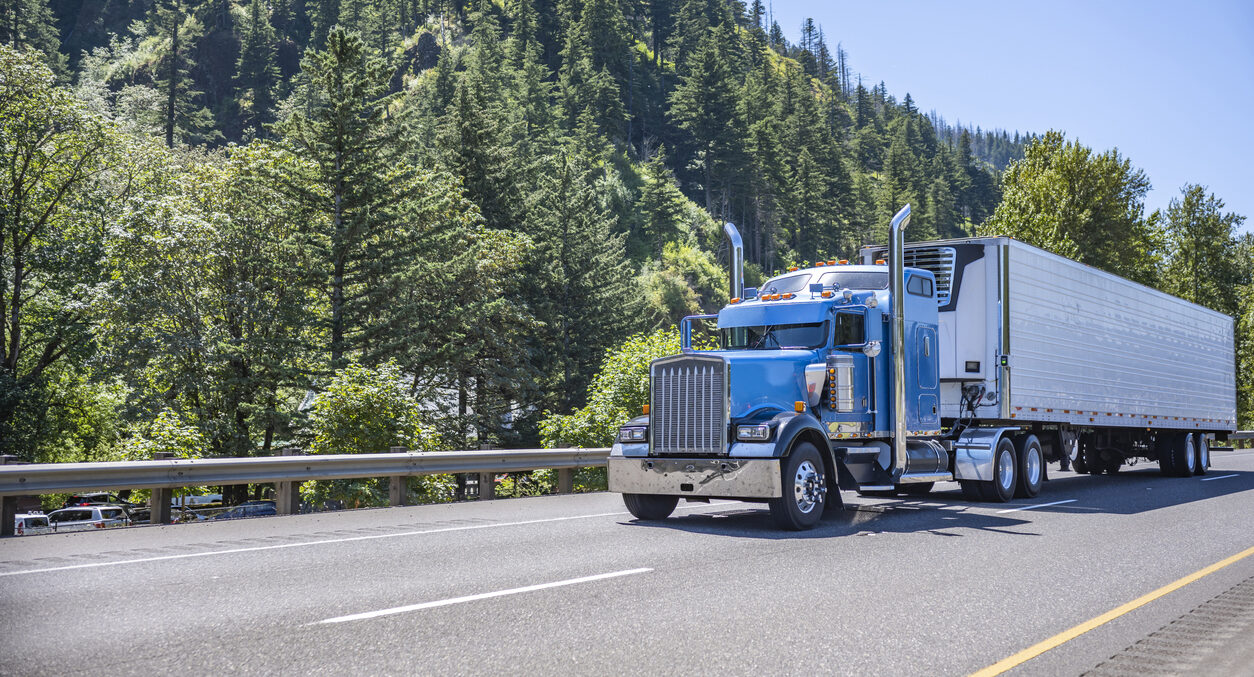
Commercial trucking insurance in Oklahoma requires a minimum of $750,000 in primary liability for non-hazardous interstate freight. Most freight brokers won’t tender loads unless you carry $1,000,000 in liability plus $100,000 in motor truck cargo coverage. Average annual premiums for an Oklahoma semi-truck run $7,000 to $14,000, with your driving record and operating radius as the biggest factors in your final rate.
Key Takeaways
- Intrastate operations are regulated by the Oklahoma Corporation Commission (OCC).
- Interstate operations fall under the Federal Motor Carrier Safety Administration (FMCSA).
- The average annual cost for a standard semi-truck policy is $7,000 to $14,000.
- Freight brokers typically require $1,000,000 in primary liability plus $100,000 in cargo coverage.
- New authorities pay 20% to 40% more than established fleets due to a lack of safety history.
- Alvix Insurance Group builds custom coverage packages for Oklahoma motor carriers.
Commercial Trucking Insurance Requirements in Oklahoma
Compliance is the financial backbone of a transport business. Which rules apply to you depends on where your freight travels.
Intrastate vs. Interstate: Who Regulates What?
Motor carriers operating only within Oklahoma follow OCC intrastate rules. Carriers that cross state borders must follow federal rules enforced by the U.S. Department of Transportation (USDOT).
| Requirement | Intrastate (Oklahoma-only) | Interstate (crosses state lines) |
|---|---|---|
| Regulated by | Oklahoma Corporation Commission (OCC) | FMCSA |
| ID required | OCC intrastate authority | USDOT number, plus an MC number for most for-hire carriers |
| Federal filings needed | Generally not required | BMC-91 or BMC-91X, plus MCS-90 endorsement |
| Minimum liability | Set by OCC rule, varies by cargo | $750,000 for non-hazardous freight, up to $5,000,000 for hazmat |
| Typical use case | Local and regional hauls that stay inside Oklahoma | Any load crossing into another state |
Federal law sets specific liability minimums based on your freight classification:
- Non-Hazardous General Freight: $750,000 minimum liability limit.
- Oil Transport Operations: $1,000,000 minimum liability limit.
- Hazardous Materials (Hazmat): $5,000,000 minimum liability limit.
Meeting the legal minimum keeps you compliant, but it rarely wins you high-paying freight contracts. Shippers generally expect $1,000,000 in primary liability to limit their own risk exposure.
2026 Average Rates for Oklahoma Motor Carriers
Oklahoma trucking insurance costs range from around $3,000 a year for a box truck to $30,000 a year for a tank truck, with your vehicle class, gross weight, and operating hazards driving most of that spread.
| Vehicle Type | Average Annual Premium Range |
|---|---|
| Semi Truck Insurance | $7,000 – $14,000 / year |
| Hot Shot Trucking Insurance | $5,000 – $10,000 / year |
| Heavy Haul Trucking Insurance | $12,000 – $28,000 / year |
| Logging Truck Insurance | $9,000 – $20,000 / year |
| Reefer Truck Insurance | $8,000 – $16,000 / year |
| Box Truck Insurance | $3,000 – $8,000 / year |
| Dump Truck Insurance | $6,000 – $12,000 / year |
| Tank Truck Insurance | $12,000 – $30,000 / year |
| Flatbed Truck Insurance | $7,000 – $14,000 / year |
| Tow Truck Insurance | $6,000 – $15,000 / year |
Your final out-of-pocket expenses depend heavily on your chosen deductible structures and fleet safety scores. Review our extensive About Trucking Insurance resources to better interpret these variables.
Key Factors Influencing Your Premium Costs
Underwriters weigh several variables to set your rate. Understanding them helps you take direct control of your insurance costs.
- Operating Radius: Local routes under 300 miles carry less statistical risk than long-haul interstate lanes.
- Driver MVRs: Your drivers’ Motor Vehicle Records, the state record of their violations and accident history, matter a lot. A single severe moving violation can raise your premium significantly.
- Authority Age: New ventures often pay 20% to 40% more than established fleets, since they don’t yet have a documented safety history.
- Equipment Value: Newer, higher-value tractors mean higher physical damage premiums.
Explore our guides on Commercial Trucking Insurance in Edmond and Commercial Trucking Insurance in Oklahoma City to analyze your local market further.
Core Coverage Types for Complete Protection
Constructing a resilient insurance package requires layering specific coverages to address your operational vulnerabilities. A cheap policy quickly becomes a financial disaster when a denied claim sidelines your equipment.
1. Motor Truck Cargo Insurance
When your trailer rolls or a reefer unit fails, cargo insurance covers the ruined freight. Brokers check this coverage closely before releasing high-value loads to you.
Carrying solid cargo insurance protects your profits from a single bad accident.
2. Physical Damage Coverage
Liability coverage pays for the other party’s property. Physical damage coverage pays to repair your own equipment. Lenders require this coverage on any financed tractors or trailers.
Your Physical Damage Protection Coverage typically includes both collision damage and comprehensive losses like theft or hail damage..
3. General Liability & Independent Protections
Fleet risk extends beyond the truck itself. Securing General Liability Insurance Coverage protects your business from third-party injuries at your terminal or during delivery.
Independent contractors should strongly consider Occupational Accident Insurance Coverage to cover medical expenses from workplace injuries, since most owner-operators aren’t covered by a traditional workers’ compensation policy.
Specialized Trucking Coverages in Oklahoma
Standard policies leave real gaps for carriers hauling specialized freight or running non-standard equipment. Your coverage needs to match the actual freight you haul.
- Hot Shot Operators: Using one-ton trucks requires more precise underwriting than standard semi coverage. Review our Hot Shot Trucking Insurance Guide for specific rating details.
- Construction Fleets: Moving raw materials involves intense site hazards. Check our Dump Truck Insurance for Owner-Operators & Fleets and Cement Trucking Insurance Coverage Guide.
- Timber Haulers: Hauling logs off-road demands highly specialized liability protection. Review our Logging Trucking Insurance: Best Policy Guide.
If you drop loaded trailers at customer facilities, you also need Trailer Interchange Insurance Protection to cover damage to equipment you don’t own.
Navigating State and Federal Filings
Insurance filings are the official link between your insurer and your regulators. Without them on file, your USDOT number stays inactive.
- Form BMC-91 / BMC-91X: The federal filing your insurer submits to FMCSA proving you carry the required liability coverage. BMC-91X is used specifically when your required limit is split across more than one insurance company; BMC-91 is used when a single insurer covers the full amount.
- Form MCS-90: A federal endorsement attached to your liability policy. It guarantees that judgments for bodily injury, property damage, and certain environmental cleanup costs from a covered accident will be paid up to the federal minimum, even if something in your underlying policy would otherwise exclude the claim. It does not increase your coverage limits, and you’re still responsible for reimbursing your insurer afterward.
Your agent must file these documents electronically the moment your policy becomes active.. For specific filing requirements in nearby jurisdictions, review Commercial Trucking Insurance in Texas and Commercial Trucking Insurance in Kansas.
Real Scenarios: An owner-operator based in Norman secured the FMCSA minimum $750,000 liability policy to save money. When the carrier tried to book a lucrative automotive parts load, the broker rejected them outright, since the broker’s own corporate policy required $1,000,000 in liability. The operator lost roughly $3,200 in gross revenue trying to save about $45 a month on premium.
This is a common trap: the legal minimum keeps you compliant, but it can quietly lock you out of your most profitable freight.
Actionable Strategies to Lower Your Insurance Premiums
Controlling fleet expenses demands aggressive and proactive risk management. Underwriters penalize ambiguity and reward documented safety protocols.
- Enforce strict MVR standards. Hire drivers with clean records. Severe violations trigger real rate increases at renewal.
- Maintain continuous coverage. Gaps in coverage signal risk to underwriters and usually mean a pricing penalty.
- Install dash cameras. Inward and outward-facing footage helps resolve contested claims faster and more cleanly.
- Raise your deductible where it makes sense. Increasing your physical damage deductible lowers your monthly premium, as long as you have the cash reserves to cover a claim.
- Review your lanes. Sticking to regional routes generally reduces your risk exposure compared to national, cross-country hauling.
Carriers operating near specific logistics hubs should also review regional dynamics. Explore Trucking Insurance in Broken Arrow and in Lawton.
FAQs
Secure Operations with Alvix Insurance
Navigating commercial transport insurance takes a dedicated partner who understands both Oklahoma’s rules and the freight market. At Alvix Insurance, we build commercial trucking insurance for Oklahoma owner-operators and larger interstate fleets alike.
We refuse to write bare-minimum, thin policies that leave your assets dangerously exposed to devastating claims or broker rejections.
Our expert team analyzes your exact freight lanes, equipment types, and safety scores to craft bulletproof coverage structures.
Support with FMCSA and State Compliance
Partner with Alvix Insurance today to lock in aggressive 2026 rates. Contact our underwriting team to protect your fleet, satisfy all FMCSA mandates, and drive your business forward with absolute financial confidence.
Sources: FMCSA Registration, Oklahoma Corporation Commission, Transportation Division


