
Table of contents
- Key Takeaways
- What an MC authority insurance lapse actually is
- The FMCSA insurance cancellation notice, and who files what
- What MC authority revoked for insurance actually takes away
- The 3 gaps that revoke fully-paid carriers
- Out-of-service orders and what hauling on a lapsed filing costs
- How to reinstate MC authority after an insurance lapse
- FAQs
- Conclusion: check the status nobody checks
An MC authority insurance lapse means FMCSA no longer holds a valid liability filing for your MC number.
Your authority stops being valid even though the truck, the loads, and the driving record have not changed. Your insurer files the cancellation notice, a clock starts, and only a new filing stops it.
New here? Start with FMCSA compliance for interstate trucking.
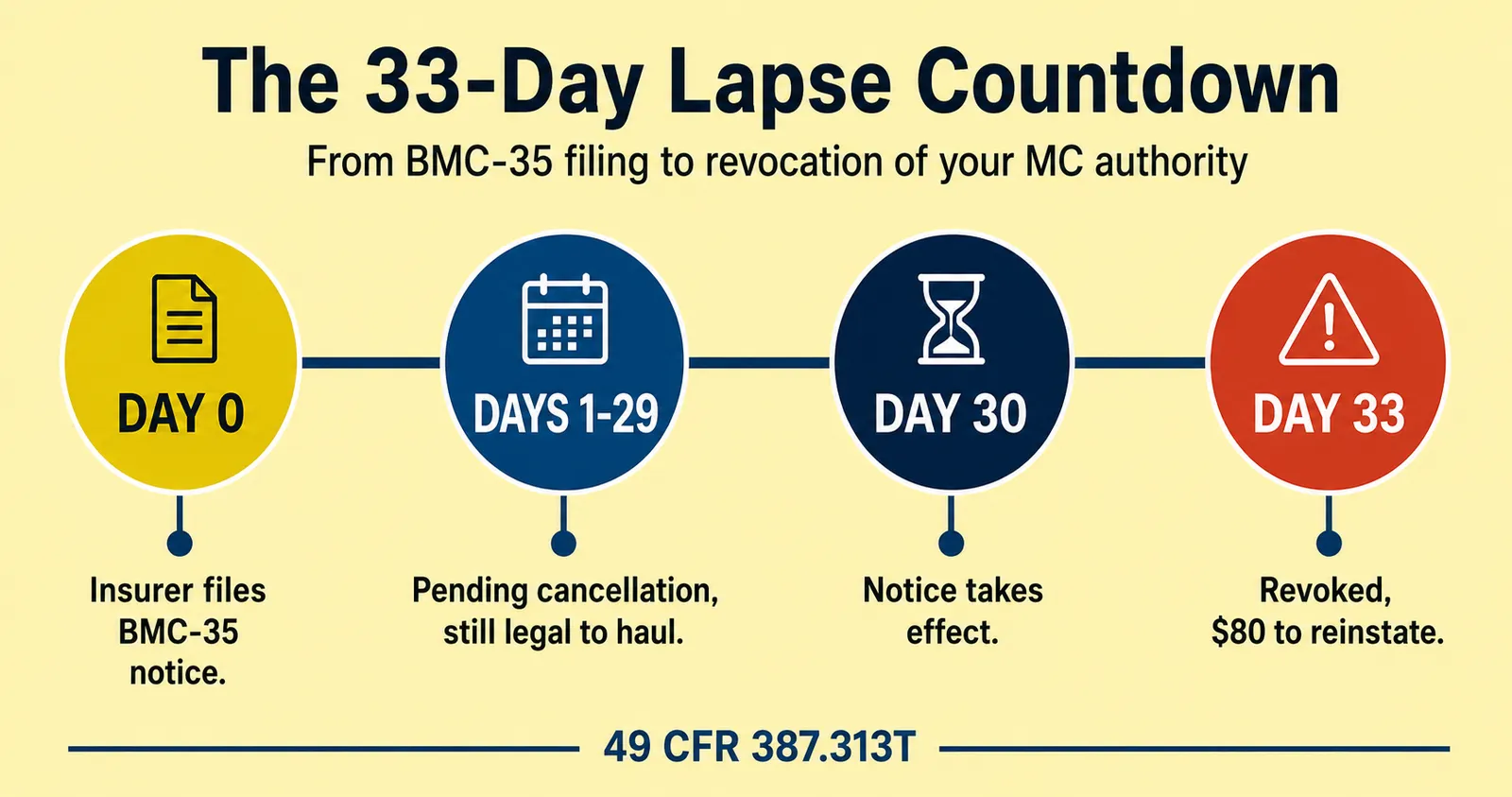
Quick Answer: Your insurer files a notice of cancellation. Under 49 CFR 387.313T it cannot take effect for 30 days. FMCSA needs roughly 3 more days to process the revocation, so the real window is 33 days. Reinstatement costs $80 plus a replacement filing.
Key Takeaways
- A lapse is a filing failure first. A paid, active policy still loses authority if the filing never posts.
- The clock starts when FMCSA receives the notice, not when your policy ends.
- Revocation is narrow. Your CDL, USDOT number, registration, and safety rating stay untouched.
- The trucking insurance lapse consequences that hurt are commercial. Brokers re-vet you for 6 months.
- The MC authority reinstatement fee is $80 on Form MCSA-5889. Insurance-only cures take 3 to 10 days.
- Parking a truck? File Form OCE-46 first, or the revocation becomes involuntary.
What an MC authority insurance lapse actually is
A lapse is the gap between your old liability filing going invalid and a new one posting. FMCSA reads financial responsibility as a filing submitted by your insurer, not as the policy in your glovebox.
That is why this catches careful operators. We see it most on accounts that never missed a payment.
The 4 statuses FMCSA shows, and what each one allows
| FMCSA status | What it means | Legal to haul for hire? | Time to clear |
|---|---|---|---|
| Authorized for Property | Valid insurance filing and BOC-3 on record | Yes | Not applicable |
| Insurance pending cancellation | Insurer filed a cancellation with a future effective date | Yes, until that date | 30 days to replace |
| Revoked | No valid filing after the notice period closed | No | 3 to 10 business days |
| Out of service | Enforcement order, separate from filing status | No | Depends on the order |
“Insurance pending cancellation” is the status almost nobody checks. It is a free warning, and everything after it costs money.
Filing lapse, coverage lapse, and the version that ends companies
- Filing lapsed, coverage active. New policy bound, old notice posted first. Paperwork only, cheapest fix.
- Coverage lapsed, no claim. The policy genuinely ended. Real exposure, nothing behind it.
- Coverage lapsed, claim inside the gap. No policy limit applies because no policy applies. Your MCS-90 endorsement rides on that same dead policy.
The FMCSA insurance cancellation notice, and who files what
Your insurer files this notice, never you. The rule is blunt: certificates “shall not be cancelled or withdrawn until 30 days after written notice has been submitted to the FMCSA.”
The 5 filing forms that decide your status
- BMC-91 or BMC-91X: certificate of insurance proving federal minimum liability. BMC-91X is the single-insurer version.
- BMC-34: cargo liability certificate, required for household goods carriers.
- BMC-35: notice of cancellation for a policy. This form starts your clock.
- BMC-36: same notice, for a surety bond instead of a policy.
- BOC-3: process agent designation. A lapsed BOC-3 blocks reinstatement even after insurance posts.
Minimums under 49 CFR 387.9 run $750,000 general freight, $1,000,000 oil and listed hazardous substances, $5,000,000 top hazmat. Filing under your limit fails like filing nothing, so match your primary liability limit and cargo coverage to what you actually haul.
Form E and Form K: the state half nobody watches
The Form E is the uniform state certificate for intrastate authority. While Form K is its cancellation notice, filed with the state agency on similar 30-day terms. Washington publishes the actual Form K notice.
Texas files through TxDMV, Pennsylvania through the PUC, New Jersey through the MVC. Check both records in every state where you hold authority, because intrastate authority can drop while SAFER still reads authorized.
What MC authority revoked for insurance actually takes away
Revocation removes for-hire permission under your MC number. The damage is commercial rather than legal.
| Asset | Status during an insurance revocation |
|---|---|
| MC number | Kept, marked revoked, reinstatable under the same number |
| USDOT number | Active and unaffected |
| CDL and driving record | Untouched |
| FMCSA safety rating and CSA scores | Unchanged by the filing lapse itself |
| Broker contracts | Suspended by the broker, not by FMCSA |
| Intrastate authority | Depends entirely on your Form E filing |
| UIIA port and rail access | Suspended, and re-approval is its own queue |
| State and federal permits | Held, but useless without active authority |
The broker freeze that costs more than the fee
Broker compliance software watches status continuously, and a revocation stays visible in your history after reinstatement.
Brokers then apply new-carrier rules, commonly 6 months of clean history before better freight reopens. For 1 truck grossing $18,000 a month, a 3-day gap becomes a five-figure hit.
The 3 gaps that revoke fully-paid carriers
Two of these three happen while you hold an active, fully-paid policy.
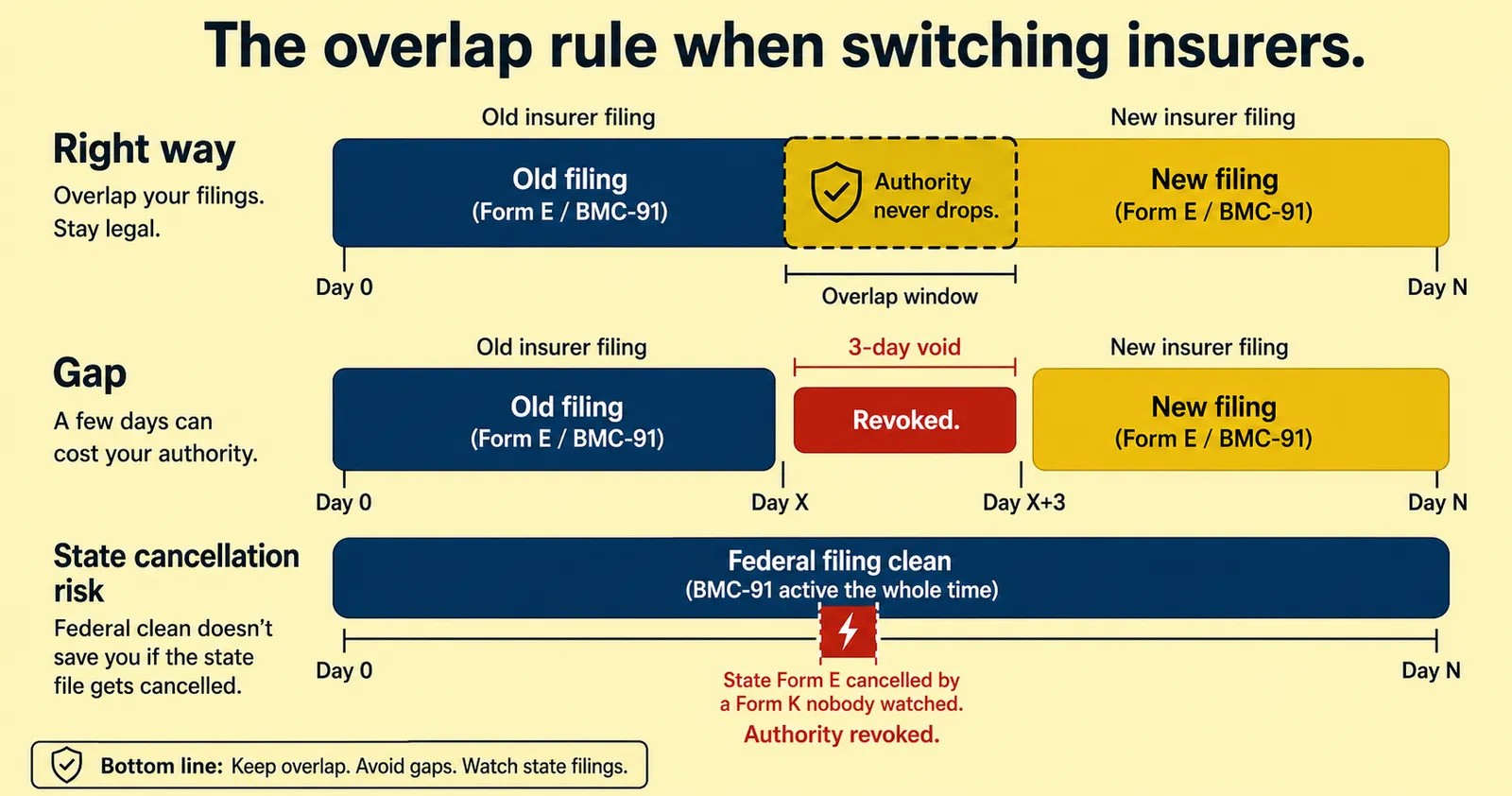
- The old insurer files before the new one posts. Binding and filing are separate steps at most carriers. Get the new filing accepted 10 business days before renewal.
- A bounced payment cancels the policy behind the filing. An NSF return of even $67 triggers automatic cancellation, which triggers BMC-35. Nobody calls first.
- The federal filing is fine and the state one is not. Two records, two agencies. An insurer switch breaks one, leaves the other intact.
One more trap: your MCS-150 biennial update is due in the month matching the last digit of your USDOT number, in odd or even years set by the second-to-last digit.
A DOT compliance checklist catches it.
Out-of-service orders and what hauling on a lapsed filing costs
Hauling without valid registration carries a statutory floor of $10,000 per violation under 49 USC 14901(a), every extra day counted separately.
Seen $13,676, $16,000, or $22,000 elsewhere? Those are different years’ inflation adjustments, not the floor.
Three things go wrong at once on a load moved after revocation:
- The load may not get paid. Broker contracts routinely allow withholding on unauthorized freight.
- A claim has no policy behind it. Loss hits your assets, and the claims process never starts.
- The violation follows the MC. It surfaces in underwriting and broker vetting for years.
Underwriters read a lapse as a signal about how the business is run. It usually costs preferred-tier pricing for 1 to 3 renewals.
How to reinstate MC authority after an insurance lapse
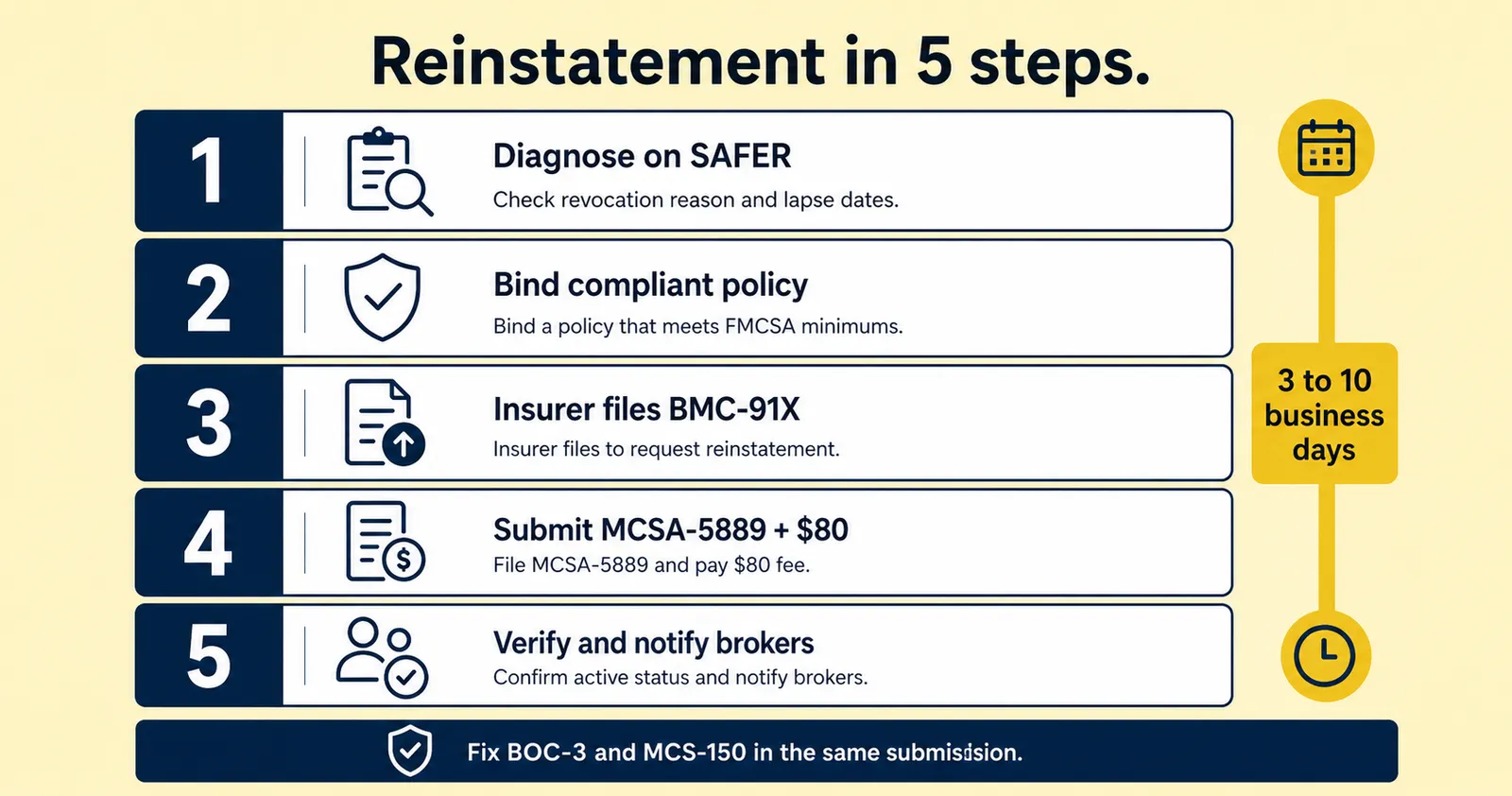
Order matters more than speed. Skipping the diagnosis step is how carriers pay the $80 twice.
- Pull your record on SAFER first. If BOC-3 or MCS-150 is also flagged, fix everything in one submission.
- Bind a compliant policy meeting your 49 CFR 387.9 limit for the freight you haul.
- Have the insurer file the new BMC-91X. Get the submission date in writing.
- Submit Form MCSA-5889 with the $80 fee, then re-file any state Form E.
- Verify, then notify every broker yourself. Their monitoring software lags by days.
1. What reinstatement really costs
| Line item | Typical cost | Mandatory? |
|---|---|---|
| FMCSA reinstatement fee (MCSA-5889) | $80 | Yes |
| Insurer BMC-91X filing | $0 to $75, often bundled | Yes |
| Down payment on replacement policy | 15% to 25% of annual premium | Yes |
| State Form E re-filing | $0 to $50 per state | Form E states only |
| Third-party reinstatement service | $150 to $325 | No |
| Lost revenue, 5 to 10 days parked | $3,000 to $9,000 for 1 truck | Unavoidable once revoked |
| Post-lapse premium surcharge | 10% to 30% at next renewal | Effectively yes |
A 20% post-lapse loading rides along for 2 or 3 renewals after the authority is clean. New-authority pricing is the tier you get compared against.
2. What changed under MOTUS in 2026
FMCSA opened MOTUS to carriers and brokers in late May 2026, with carrier deadlines set at May 14, 2026. It replaces the Unified Registration System and the legacy Licensing and Insurance portal.
The mechanics held. Insurers still file for you, and 387.313T still sets the notice period. Only the submission path moved, which is why we track the MOTUS platform separately.
3. Parking a truck without losing your authority
There is no such thing as trucking liability by the load or the weekend. If your trucks genuinely sit, file Form OCE-46 for voluntary revocation before letting coverage drop.
Order is everything. Coverage dropping first makes the revocation involuntary, which can pull a safety audit into your reinstatement.
Ask about a reduced-mileage endorsement instead, since carriers surcharge accounts that toggle coverage.
FAQs
1. What happens if my MC authority insurance lapses?
FMCSA loses your proof of financial responsibility, your status goes revoked in roughly 33 days, and hauling stays illegal until a new filing posts and the $80 clears.
2. How long after insurance cancels does FMCSA revoke authority?
About 33 days. The notice cannot take effect for 30 days after FMCSA receives it, and processing takes roughly 3 more.
3. Can I keep hauling while my insurance filing is pending?
Only while your status reads authorized or pending cancellation. Once it is revoked, that $10,000 per day floor applies.
4. Does switching truck insurance cancel my authority?
Not by itself. Trouble starts only when the outgoing cancellation takes effect before the new BMC-91X posts.
5. How do I know if my insurance filing was accepted by FMCSA?
Read the insurance panel on your SAFER record. It shows the insurer, filing type, coverage amount, and effective date.
6. Can I recover money if my agent failed to file?
Sometimes. Carriers do pursue insurers and agents for downtime losses when a paid policy was never filed. Keep premium receipts and denied load offers.
Conclusion: check the status nobody checks
A lapse is a filing gap, and filing gaps are visible before they get expensive. The warning status costs nothing to check.
Do these 3 things today:
- Pull your MC number on SAFER. Note the insurer, coverage amount, and effective date.
- Calendar your policy expiration 30 days out, labelled as the filing task, not the renewal.
- Running intrastate loads in a Form E state? Confirm that filing separately.
Talk to someone who files these daily
Alvix Insurance Group has placed and filed trucking coverage since 2014, across 23-plus licensed states. Sequencing is the part we control: we confirm the new BMC-91X posts before anything cancels, and 24/7 certificate access means a broker’s COI request never waits until Monday.
Already revoked, or staring at a pending-cancellation notice? Bring your MC number and we will read the filing record with you, quote a replacement, and coordinate the re-filing in one conversation.
Contact Alvix about a lapsed filing or call (305) 909-6444. Shopping ahead of renewal instead? Request a quote.
Related reading: owner-operator policy options, every coverage we place, and the questions truckers ask us most.