
A load is ready, the freight broker wants your certificate of insurance, and your insurer’s phone line is on hold. That moment is where a trucking insurance broker earns their keep.
A trucking insurance broker shops your trucks, drivers, and freight across several insurers, then places the policy that fits. After binding, the broker handles your filings, certificates, changes, claims, and renewals for every trucking coverage you carry.
Quick answer: A trucking insurance broker is a licensed insurance producer who represents the motor carrier. The broker shops multiple insurers, binds the policy, confirms FMCSA filings, issues certificates of insurance (COIs), and supports claims and renewals. The insurer pays the broker a commission, usually 8% to 10% of premium.
Key takeaways
- Your insurer files the BMC-91X. Your broker confirms it posts under the right name and USDOT number.
- Trucking commission runs about 8% to 10%, and it’s already inside your premium.
- Most insurers accept 1 submission per account, so 2 brokers can’t pitch you to the same insurer.
- A broker of record letter switches brokers mid-term with no cancellation penalty.
- Start renewal shopping 60 to 90 days before expiration.
What a trucking insurance broker does from quote to renewal
A trucking insurance broker manages 4 stages: packaging your risk, shopping it, binding and filing, then servicing the policy. Most owner-operators only notice the quote.
The other 3 stages decide whether your authority stays active and your claims get paid.
The 8 core jobs, in the order they happen:
- Collects VINs, driver MVRs, commodities, radius, garaging address, and 3 to 5 years of loss runs.
- Write a submission that explains your safety record before the underwriter asks.
- Sends it only to insurers whose appetite fits your freight and experience.
- Negotiates deductibles, payment plans, and endorsements with the underwriter.
- Compares quotes side by side: limits, exclusions, and each insurer’s A.M. Best rating.
- Binds coverage and confirms your FMCSA and state filings posted.
- Issues COIs and processes each truck, driver, or lienholder endorsement.
- Reports claims, reviews premium audits, and remarkets 60 to 90 days before renewal.
Who files your BMC-91X, MCS-90, and state forms
Buying a policy doesn’t activate your MC authority. FMCSA needs proof of insurance on file, and each form comes from a specific party.
| Filing | What it proves | Who files it |
| BMC-91X | Federal minimum liability | Your insurer, electronically with FMCSA |
| MCS-90 | Public-protection guarantee | Your insurer, attached to your policy |
| Form E / Form H | State liability or state cargo filing | Your insurer, with the state |
| BOC-3 | Process agents in every state | A process agent company |
Your broker requests each filing and checks that the legal name and USDOT number match exactly. Our BMC-91 filing guide shows what happens when they don’t.
49 CFR 387.9 sets $750,000 for general freight, $1,000,000 for oil, and $5,000,000 for many hazmat loads. Most freight brokers still require $1,000,000 in liability and $100,000 in cargo.
What a broker can and cannot do in a claim
The insurer decides whether a claim pays and how much. Your broker controls the speed and the paperwork.
- Can: report the claim on day 1 to the right claims unit.
- Can: gather photos, the police report, ELD logs, and bills of lading.
- Can: push a silent adjuster and explain which exclusions apply.
- Cannot: approve, deny, or set the payout amount.
Our guide to trucking insurance claims walks through each step after an accident.
Trucking insurance broker vs agent vs buying direct
A captive agent sells for 1 insurer. An independent trucking insurance agent sells for the insurers they’re appointed with.
A broker represents you and reaches extra markets through wholesalers. A direct writer sells its own policy, with no advocate between you and the claims desk.
| Particulars | Captive agent | Independent agent | Broker | Direct writer |
| Represents | The insurer | Appointed insurers | You | The insurer |
| Insurers quoted | 1 | Several | Several, plus wholesale | 1 |
| Best fit | Standard risks | Clean accounts | New authority, losses, specialty freight | Clean single truck |
| Weak spot | 1 appetite | Appointment limits | Service quality varies | No claim advocate |
Most states issue 1 producer license, so the relationship matters more than the title. California law draws the line clearly: an agent acts for the insurer, and a broker acts for the buyer.
The wholesale layer behind hard-to-place trucking policies
New authorities, prior losses, and hazmat often land with excess and surplus (E&S) insurers. Your retail broker reaches them through a wholesale broker or a managing general agent (MGA).
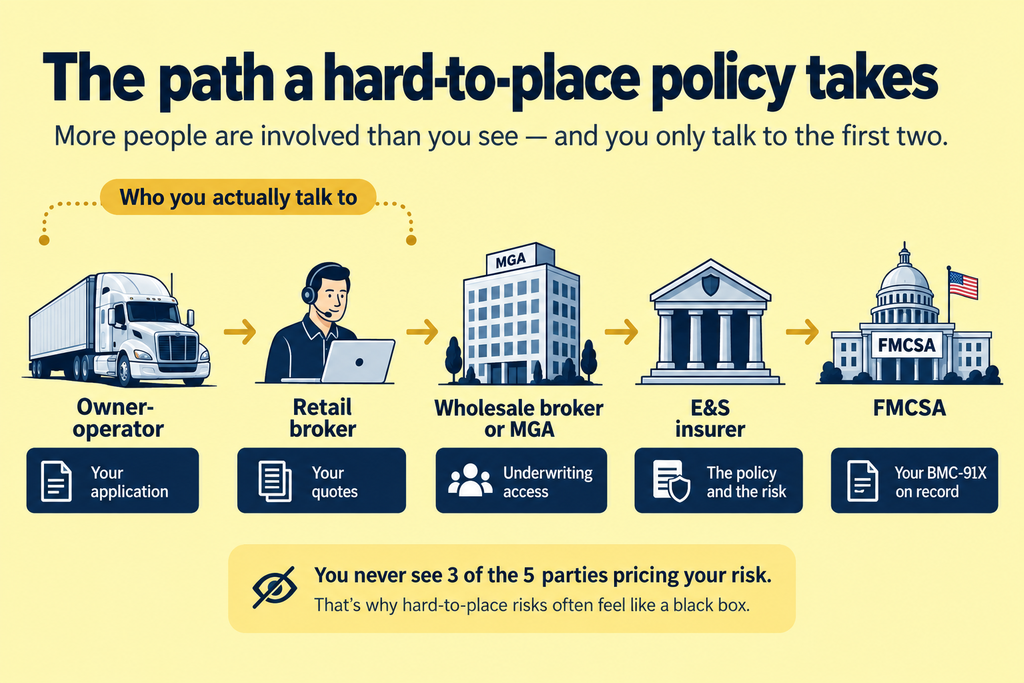
E&S placement adds 3 costs to your invoice:
- Surplus lines tax: 4.94% in Florida and 4.85% in Texas, per the Florida surplus lines tax table and the Texas Comptroller.
- Minimum earned premium: commonly 25%, kept by the insurer even if you cancel early.
- Policy and inspection fees: usually flat and non-refundable.
Trucking insurance broker vs freight broker
A trucking insurance broker places insurance under a state producer license. A freight broker books loads under FMCSA broker authority and a $75,000 BMC-84 bond.
The 2 jobs meet at the COI. Freight brokers set the limits, and your insurance broker builds the policy to hit them.
How trucking insurance brokers get paid
Insurers pay trucking insurance brokers a commission, usually 8% to 10% of premium, built into your price. Admitted insurers file their rates with the state. As a result, buying direct rarely costs less for the same policy.
On a $14,000 policy, that’s $1,120 to $1,400 a year, roughly $100 a month. It covers dozens of COIs, every endorsement, and your claims.
That math is why agencies that dabble in trucking go quiet after the sale. Specialists build their whole operation around that service volume.
Ask for every extra line in writing before you bind:
- Broker or agency fees (some states restrict these)
- Premium finance interest on monthly payment plans
- Surplus lines tax and stamping fees on E&S policies
When an owner-operator needs a trucking insurance broker
An experienced owner-operator with a clean record hauling dry van freight can buy direct. A truck insurance broker earns the commission when your account is harder to place, or your loads carry extra insurance demands.
| Your situation | Best route | Why |
| New MC authority | Broker | Few insurers write new ventures |
| Port drayage or intermodal | Broker | Needs a UIIA-compliant policy and interchange endorsement |
| Hazmat or tanker | Broker | Higher limits and specialty markets |
| Prior claims or CSA alerts | Broker | E&S markets and a stronger submission |
| Clean record, 3+ years, dry van | Either | Direct writers compete well here |
| Fleet of 6 to 25 trucks | Broker | Deductible design and safety credits |
A commercial truck insurance broker can also split coverage. Primary liability stays with 1 insurer while physical damage and cargo move to another.
That split is a common fix when a renewal nearly doubles with no claims. It keeps your filings untouched while cutting the most overpriced lines.
Check the commodity line on your current policy, too. A truck rated “general freight” that actually hauls cars or reefer loads is the top cause of the disputed cargo claims we see.
How to choose a trucking insurance broker
Pick a trucking insurance broker who writes trucking every day, names the insurers they’ll approach, and turns COIs around fast. Verify their producer license on NIPR’s license lookup before sharing your loss runs.
8 questions to ask before you sign
- What share of your book is trucking?
- Which insurers will you approach for me, and why?
- Do you have E&S access through a wholesaler?
- Does your underwriter have “power of the pen” to adjust a quote without a new submission?
- How are you paid, and are there any fees?
- What’s each insurer’s A.M. Best rating? (Look for A- or better.)
- How fast do COIs go out, including weekends?
- When will you start my renewal?
Red flags that mean keep shopping
- A quote with no questions about drivers, radius, or freight
- Your commodity listed as “general freight” when it isn’t
- A risk retention group quote with no warning that some freight brokers reject them
- Pressure to bind today
- Renewal quotes that arrive the week your policy expires
How to shop 2 brokers without blocking your own markets
Most insurers accept 1 submission per account. The first broker to submit reserves to that insurer, and a second broker gets told the market is “blocked.”
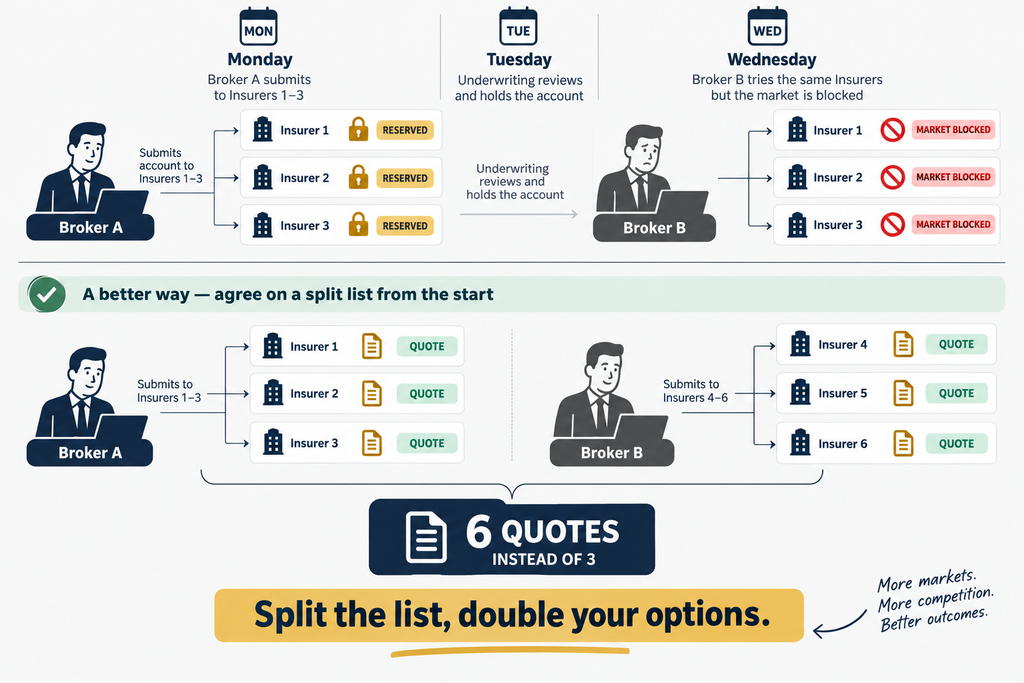
Tell each broker which insurers already quoted you. You avoid duplicate submissions and get more real options.
How to switch brokers mid-term without a coverage gap
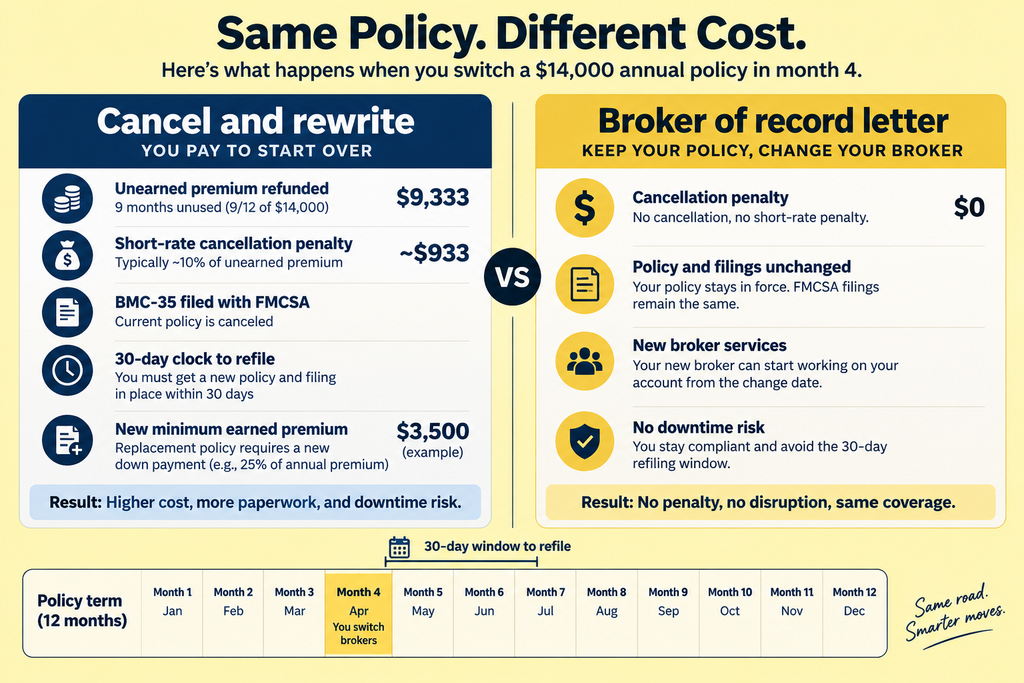
Sign a broker of record (BOR) letter naming the new broker on your current policy. Your coverage, filings, and payment plan stay in place.
Cancelling and rewriting costs more. A short-rate cancellation often keeps about 10% of unearned premium, and the insurer files a BMC-35 notice with FMCSA.
Under 49 CFR 387.313, you then have 30 days before coverage legally ends. Here’s what happens when MC authority insurance lapses.
Why owner-operators choose Alvix Insurance Group as their broker
Slow COIs, silent adjusters, and surprise renewals are the 3 complaints we hear most from carriers who switch to us. Alvix Insurance Group is built around fixing all 3.
- Trucking only, since 2014. Every account manager works trucking accounts every day.
- 1 dedicated account manager. Endorsements and renewals go to someone who already knows your trucks.
- COIs 24/7, weekends included. Your load doesn’t wait for Monday.
- Claims followed to close. We report the claim and chase the adjuster for you.
- Licensed in 23 states. One broker covers your whole lane map.
Get a trucking insurance quote built around your freight. Send your USDOT number, truck list, and commodities. We’ll shop for the insurers that fit and show you every line of the price, fees included. Get your free trucking insurance quote!
FAQs
Conclusion
A trucking insurance broker does far more than find a price. The broker packages your risk, reaches the right markets, confirms your filings, and stays with you through COIs, claims, and renewals.
Choose one who specializes in trucking, discloses every fee, and shows A.M. Best ratings on each proposal. For more quick answers, visit the trucking insurance FAQ.


