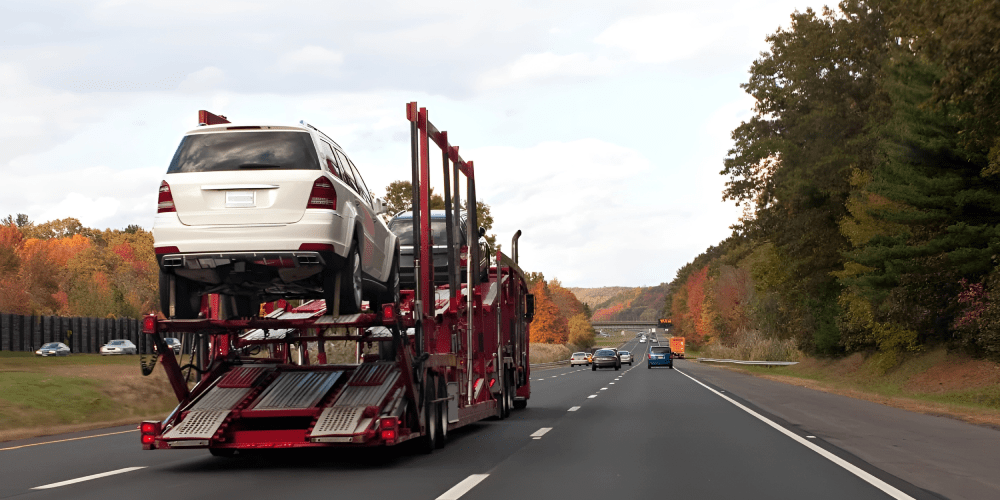
Auto hauler insurance in Florida costs $12,000 to $25,000 a year per truck. A correct policy combines primary liability, auto-hauler cargo insurance, and physical damage on your rig. Skip any one of the three, and a routine claim can turn into a denied one.
Quick Answer: Liability limits depend on your route: interstate haulers need $750,000-$1,000,000, while intrastate Florida carriers also need a separate Form E filing on top of the policy itself. Cargo coverage has to match your maximum load value, not your truck’s value, since that gap is where most haulers end up underinsured without realizing it.
Key Takeaways
- Real Progressive quotes for a new authority running a 3-car wedge land near $17,000 a year, well above the “$50-$70/month” figures that circulate online.
- Personal auto policies exclude any commercial hauling. Insurers can deny the claim and rescind the policy once business use is confirmed.
- Credit score, claims history, and driving record move your premium, the same factors that price personal Florida auto insurance.
- If your LLC operates the truck, the policy should list the LLC as a named insured, not just the driver.
What Is Auto Hauler Insurance and Who Actually Needs It
Auto hauler insurance is built for businesses that move vehicles for someone else.
Typical operations include:
- Dealer-to-dealer relocations
- Auction runs (Manheim, Copart, IAA)
- Salvage yard transport
- Direct-to-consumer car shipping
A correct policy combines primary truck liability insurance, physical damage on your rig, and auto-hauler cargo coverage (on-hook coverage) for the vehicles on your trailer.
None of the three exist as a single line item on a standard commercial policy. That gap is why generalist insurers routinely misprice this risk.
1. What “Hauling Autos” Means in Insurance Terms
Underwriters use “auto hauling” for any operation where a vehicle rides as cargo, on an open wedge trailer, a stinger ramp, or an enclosed hauler, instead of being driven under its own power.
Standard motor truck cargo (MTC) policies are written for boxed freight and often exclude vehicles entirely. If your policy doesn’t specifically say “auto hauler cargo” or “on-hook coverage,” assume your cars aren’t covered.
2. Personal Auto Policies Do Not Cover Business Hauling
This is the costliest mistake new haulers make.
One claims adjuster summed it up in a widely shared trucking thread: “When you get into an accident, they will find out and deny your claims, and you will be left holding the bag.”
Moving vehicles for money is commercial use, whether it’s a full-time business or a side hustle between auctions, and filing a business claim under a personal policy is grounds for denial.
Example: A hauler moves a friend’s car “as a favor” using a personal policy, then gets rear-ended while loaded with two more vehicles for a paying customer. The insurer’s investigation finds a pattern of paid hauls on the same policy. The claim is denied, and the driver covers both repairs out of pocket.
Auto Hauler Insurance Coverage You Actually Need
A correctly built Florida policy runs six coverage types together:
- Primary auto liability
- Auto-hauler cargo (on-hook) coverage
- Physical damage coverage
- General liability
- Garagekeepers coverage
- Occupational accident or workers’ compensation
Skip any one, and a single bad day can end the business.
1. Primary Auto Liability
- Primary liability lets your truck legally operate, paying for injuries and property damage to others when your driver is at fault.
- Federal minimums start at $750,000, but most freight brokers and dealer contracts won’t assign a load without $1,000,000 on file.
2. Auto Hauler Cargo Insurance (On-Hook Coverage)
This covers the cars on your trailer against collision, fire, theft, and vandalism. You need two numbers, not one:
- Per-vehicle limit: covers a single car damaged in transit.
- Per-load aggregate limit: covers the full trailer if several vehicles are damaged at once.
A loaded 9-car carrier can move $400,000 or more in vehicle value. A cargo limit that only reflects your truck’s value leaves every full trailer underinsured.
3. Physical Damage, General Liability, and Garage keepers
Three more coverages round out a correct policy:
- Physical damage repairs your own tractor and trailer after a collision. Open trailers run $80,000-$120,000 to replace; enclosed haulers run $150,000-$300,000.
- General liability covers non-driving risk, like tie-down scratches during loading. This is distinct from your cargo freight insurance protection, which only protects the vehicles themselves.
- Garagekeepers coverage protects vehicles stored overnight at your lot. Your cargo policy stops covering them the moment they’re parked and unattended.
4. Occupational Accident and Workers’ Compensation
- Sole proprietors typically aren’t eligible for state workers’ comp as independent contractors.
- Occupational accident coverage fills that gap; industry groups like OOIDA offer similar plans.
- Hire one W-2 driver, and Florida law requires actual workers’ compensation instead.
How Much Does Auto Hauler Insurance Cost in Florida
Florida auto hauler policies run $12,000-$25,000 per truck annually, above the national average because of uninsured-motorist exposure and hurricane risk. Real quotes back this up.
One hot shot hauler running a Ram 4500 with a three-car wedge reported a Progressive quote near $17,000 a year for a new authority. Others in the same thread cited $12,000-$20,000, depending on driving record and years of authority.
| Operation Type | Annual Cost (Full Coverage) | Key Cost Drivers |
|---|---|---|
| Hot shot (1-3 vehicles) | $10,000-$16,000 | New authority, driver experience, radius |
| Open multi-car carrier (5-9 vehicles) | $12,000-$25,000 | Cargo value, loss history, interstate radius |
| Enclosed high-value transport | $18,000-$35,000+ | Theft severity, exotic/luxury cargo value |
What Actually Drives Your Premium Up or Down
Underwriters price your policy against eight factors:
- Operating radius and maximum cargo value per trip, not your average load.
- Equipment type. Enclosed trailers see fewer weather claims than open racks.
- CDL experience. Under two years triggers a new-venture penalty.
- Motor vehicle record, claims history, and credit score, the same factors behind personal Florida auto rates.
- Garaging ZIP code. Miami-Dade and the I-4 corridor cost more than lower-theft counties.
Dashcams and telematics give underwriters proof of safe driving. Raising your deductible from $1,000 to $2,500 cuts your premium if you keep cash reserved for it.
Shopping your renewal against two or three carriers each year, then paying annually, is the most reliable way to catch an unjustified rate hike.
Florida State vs. FMCSA Compliance Requirements
| Carrier Type | Operating Radius | Liability Requirement | Governing Body | Required Filing |
|---|---|---|---|---|
| Intrastate | Within Florida only | $300,000-$750,000 | FLHSMV / FDOT | Form E |
| Interstate | Crosses state lines | $750,000-$1,000,000 | FMCSA | MCS-90, BOC-3 |
Florida intrastate carriers must file Form E with the FLHSMV to prove continuous financial responsibility. An active policy alone does not satisfy this, and skipping the filing can suspend your authority immediately, even with paid-up coverage in force.
Interstate carriers carry the same exposure through an active MCS-90 endorsement under 49 CFR §387.
Choosing the Right Company, Program, or Wholesaler
The auto hauler insurance market splits into retail agencies and wholesalers. A retail agency shops multiple carriers on your behalf and handles COI requests and claims directly.
An auto hauler liability insurance wholesaler works differently. It sells binding authority to other agents, not to truckers, so you’ll rarely deal with one unless your agent places your policy through it. A quote with no underwriting questions about cargo value often signals a thin wholesale program.
A legitimate auto hauler insurance program names cargo as its own coverage line rather than bundling it vaguely. It also pairs you with an underwriter who asks about your trailer type and load value.
As one independent broker put it in a Florida insurance thread: “Talking to an independent broker is really your best option.”
Expect to provide these items with your application:
- MC/DOT number
- Three to five years of loss runs
- Driver MVRs
- Equipment list with stated values
- Operating radius
- Maximum cargo value per load
New authorities without loss history typically see a 20-40% “new venture” pricing adjustment. Most agencies bind a quote within 24-48 hours.
Auto Hauler Insurance Across Florida and Beyond
Garaging location changes your exposure. A truck running out of Sarasota faces different traffic patterns than one based near Orlando’s I-4 corridor.
Alvix Insurance Group writes auto hauler coverage across Florida and 22 additional licensed states, including haulers near Broken Arrow, Oklahoma; Jackson, Mississippi; and Covington, Georgia. Multi-state fleets get one policy structure instead of separate carriers per state.
If your trailer occasionally hauls equipment instead of vehicles, talk to your agent before binding against a general flatbed insurance policy. Mixed-use trailers need both cargo definitions listed explicitly.
Five Mistakes That Get Auto Hauler Claims Denied
- Undervaluing cargo limits: Six vehicles loaded against a four-vehicle cargo limit leaves you covering the difference yourself.
- Letting coverage lapse, even for a day: A single-day gap can trigger an FMCSA authority suspension and spikes your renewal rate for years.
- Running a personal policy for business hauls: Automatic denial once the insurer confirms commercial use, as the scenario above shows.
- Skipping garagekeepers coverage: A stolen vehicle parked overnight at your yard isn’t covered once it’s off the trailer.
- Hiring drivers without an MVR check: One driver with a hidden at-fault history can void the entire policy after a loss.
FAQs
Get Your Florida Auto Hauler Insurance Quote
A mismatched cargo limit, a missing Form E filing, or a personal policy stretched over business hauls are the three most common reasons Florida haulers find a coverage gap only after the claim is denied.
Alvix Insurance Group has placed trucking coverage since 2014, with 24/7 certificate of insurance access. Every policy is matched to your actual trailer type and cargo value, not a generic template.
Get a free quote for your Florida auto hauler insurance or contact our commercial trucking insurance team to review your cargo and liability limits before renewal.


