
A BMC-91 is the electronic proof-of-insurance filing your insurance company submits to the FMCSA. It’s not something you file yourself, and until it posts, your MC number sits in Pending, no matter how complete your new authority application otherwise looks.
In 2026, that posting is taking longer than it used to, for a reason most carriers never hear explained clearly. Below: who files it, what triggers it, why it’s stalling, and how to verify your own status in minutes.
Quick Answer: Your insurance company, or its FMCSA-registered filing agent, files the BMC-91 on your behalf. You cannot self-file it. Authority moves from Pending to Active only once this filing and your BOC-3 both post, usually within 5 to 20 days of publishing in the FMCSA Register.
Key Takeaways
- BMC-91 covers one insurer at your full liability limit. BMC-91X splits that limit across two or more insurers.
- The federal minimum is $750,000 for general freight, but most brokers now expect $1,000,000 in coverage.
- FMCSA’s new Motus platform, live since May 14, 2026, has slowed a share of filings to days or weeks.
- A binder is not a bound policy. Your insurer cannot file a BMC-91 until the policy is actually issued.
- You can check your own filing status on Motus in under two minutes.
What a BMC-91 Filing Actually Proves
A BMC-91 is a one-page federal form certifying your insurer holds a bound policy at or above your required liability limit. FMCSA reads it as one signal: insured or not insured.
1. What the Form Is Not
A BMC-91 is not your policy and not a certificate you keep in your truck. It’s a data link between your bound policy and your MC number inside FMCSA’s system, and your coverage can be valid while that link is still missing.
2. BMC-91 vs. BMC-91X vs. BMC-90
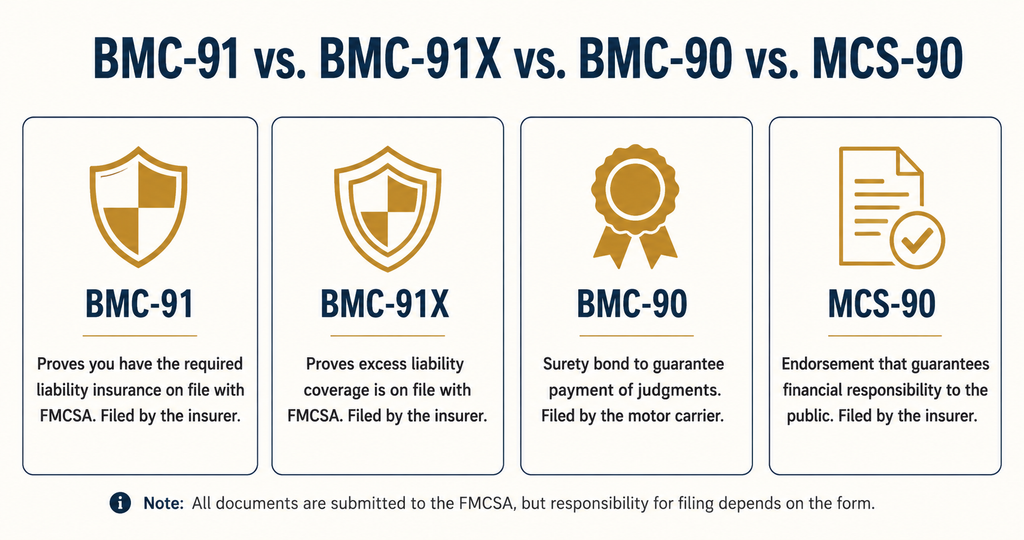
| Term | What it proves | Filed by |
| BMC-91 | One insurer covers your full limit | Your insurer |
| BMC-91X | Your limit is split across insurers | Each insurer involved |
| BMC-90 | A surety bond replaces insurance | The bonding company |
BMC-90 is rare since bonding is expensive and most underwriters steer clients toward insurance instead. If you’re also carrying an MCS-90 endorsement, that’s a fourth concept: it lives in your policy paperwork, not as a separate FMCSA filing.
Who Files the BMC-91
Your insurer files it, never you and never your agent personally. Agents facilitate the sale and bind the policy, but only the underwriting company holds FMCSA filing access.
If your agent seems unsure whether it happened, that’s usually a sign their agency mostly writes intrastate policies that never needed a BMC-91 before. See our FMCSA compliance guide for how the two connect.
Before binding, confirm three details line up exactly:
- Your legal business name matches your FMCSA registration character for character.
- Your vehicle count and radius of operation are accurate, not estimated.
- Your MC and DOT numbers appear correctly on the binder.
Get any one wrong, and your filing can sit unmatched, even when your insurer submitted it correctly.
Minimum Insurance a BMC-91 Requires
| Freight category | Federal minimum | What brokers actually require |
| General freight | $750,000 | $1,000,000 |
| Auto Haulers | $1,000,000 | $1,000,000+ |
| Certain hazmat | $5,000,000 | $5,000,000 |
The $750,000 floor was set decades ago and never indexed to freight values, so brokers raised their own bar. Some states are moving faster still; see our New Jersey liability increase breakdown. A quote at the exact legal minimum may be compliant yet commercially useless.
The 2-Filing Rule for MC Authority: BMC-91 and BOC-3 Requirements
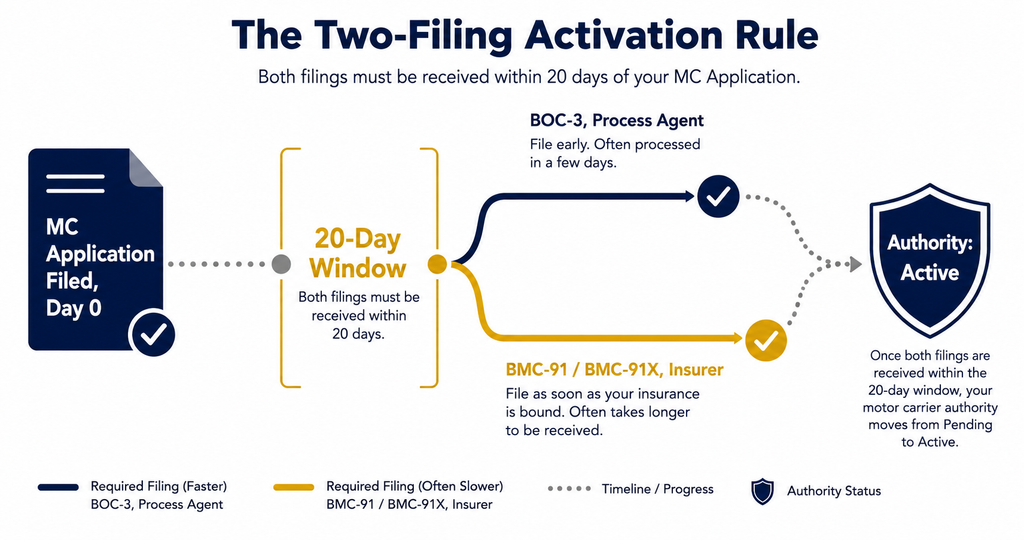
Paying the fee and getting a preliminary MC number isn’t the finish line. Under 49 CFR Part 365, authority activates only after two filings post within 20 days of your Register publication:
- BOC-3, filed by a process agent service, usually same-day.
- BMC-91 or BMC-91X, filed by your insurer once your policy is bound, the slower half.
Miss the window, and FMCSA can dismiss the application. Reapplying republishes you in the Register on a fresh date, restarting the 20-day clock and the fee. Our trucking insurance glossary defines related terms like process agent in plain language.
Why Filings Are Slower in 2026
FMCSA retired its legacy Portal and URS for a new platform, Motus, fully live since May 14, 2026. Roughly 1.8 million carriers are migrating at once, and processing that used to be automatic now often runs through manual review. Our FMCSA Motus guide covers the full rollout.
Two specific issues stall filings right now. Every Company Official needs a Login.gov account whose email must match FMCSA’s records exactly, and a mismatch locks you out entirely. Stale MCS-150 data, like an outdated vehicle count or address, gets a file flagged for manual review instead of auto-cleared.
How to Verify Your BMC-91 Posted
- Search your DOT number on SAFER and open the Insurance tab.
- Ask your insurer for the filing confirmation number and timestamp, not just a verbal yes.
- Confirm your Login.gov email matches your FMCSA Portal email exactly.
- Check your MCS-150 for stale vehicle, address, or operation data.
- Confirm your certificate of insurance is uploaded separately on any load boards you use.
SAFER and load-board platforms like RMIS are separate databases. A clean federal record and an unverified load-board flag can be true at once.
Switching Insurance Carriers Mid-Authority
Outgoing insurers generally must give 30 to 35 days’ cancellation notice, even after you’ve bound new coverage. That creates a window where SAFER shows a pending cancellation while your new BMC-91X is posting, and brokers often hesitate to tender loads during it.
One detail most guides skip: switching agents alone doesn’t trigger a new filing. Only switching the actual underwriting insurer does, since the BMC-91 follows the insurer, not the agent. Have your new insurer file the BMC-91X immediately, and have your agent, not you, send the new certificate of insurance to load boards directly.
Common BMC-91 Mistakes
- Assuming a quote equals coverage, when a policy has to be bound first.
- Working with an agency that has never filed for interstate for-hire trucking.
- Confusing BMC-91, BMC-91X, and MCS-90 when a broker asks about coverage.
- Never checking SAFER directly and hearing about a problem from a broker instead.
- Letting your legal business name differ between your FMCSA registration and binder.
Frequently Asked Questions About BMC-91 Filing
Get Your BMC-91 Filed Right the First Time
A BMC-91 moves only as fast as the insurer behind it. Alvix Insurance Group writes commercial trucking coverage across 23+ states, and our underwriting team files BMC-91 and BMC-91X forms directly with FMCSA as a standard part of binding your policy, not a step you have to chase.
If you’re setting up new operating authority or stuck watching Pending longer than it should take, get a free trucking insurance quote from Alvix and let us confirm exactly where your filing stands.


